

USD-JPY News and Analysis: Yen Under Pressure Amid BoJ Policy Shifts
The global currency markets in early 2026 are witnessing a significant transformation in the Japanese Yen’s trajectory. For investors tracking USD-JPY News and Analysis, the focus has shifted from simple carry trades to the fundamental restructuring of Japan’s monetary policy. As the Federal Reserve signals a potential pause in its tightening cycle, the Bank of Japan (BoJ) is finally stepping out of its decade-long ultra-loose shadow, creating high-stakes volatility for the USD/JPY pair.
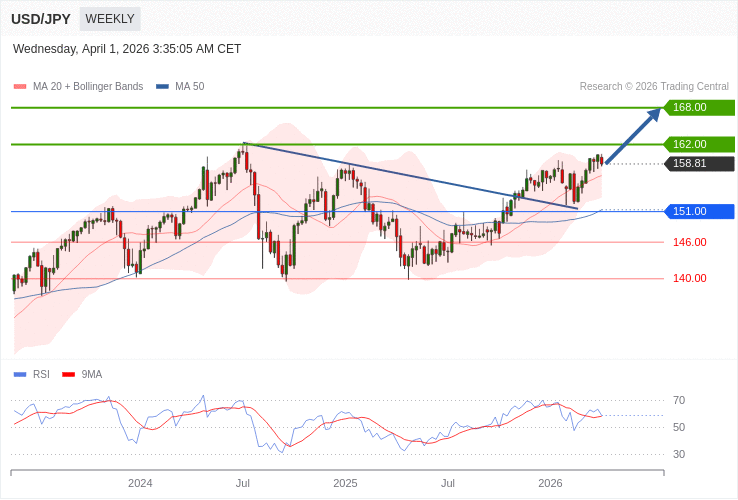
USD/JPY
Weekly Analyst Views
USD/JPY MT: the upside prevails.
1. The “Sanaenomics” Effect and BoJ Rate Hikes
A cornerstone of recent USD-JPY News and Analysis is the emergence of “Sanaenomics” under Prime Minister Sanae Takaichi. Her administration’s proactive fiscal policies have forced the Bank of Japan to accelerate its normalization process. In January 2026, market participants are pricing in a 0.25% rate hike, which would bring the policy rate to 1.00%—a level not seen in years.
This hawkish shift is putting immense pressure on the US Dollar. As Japanese domestic yields rise, the “Yen Carry Trade” is rapidly unwinding. To navigate these complex movements successfully, traders must understand how to follow forex signals effectively, ensuring they capture the momentum shifts triggered by BoJ Governor Kazuo Ueda’s press conferences.
2. Technical Breakdown: The 158.95 Line in the Sand
The intraday bias for USD/JPY remains bearish as the pair struggles to regain footing after a stark rejection at the 159.20 resistance zone.
The 158.95 Pivot: This is the most critical level for today. As long as the price stays below this mark, the pressure remains on the downside. A failure to reclaim this level suggests that bulls are losing conviction ahead of the election.
Targeting 157.55: A sustained break below the 158.10 support level is likely to accelerate selling toward 157.55. This level is a high-confluence zone, aligning with the 100-day Moving Average and acting as a major structural floor.
Alternative Scenario: If bulls manage to reclaim 158.95, we could see a rapid short-squeeze toward 159.45 as stop-losses are triggered. Professional traders often use high-liquidity brokers like Exness to manage such high-volatility breakouts.
Macro Focus: The Yen’s “Real Wage” Reckoning
Current Rate: 156.40 | February High: 157.90 | Sentiment: Volatile / Moderate Bearish
USD-JPY News and Analysis The Fundamental Pivot
Japan’s core inflation has officially stayed above the 2% target for 46 consecutive months. However, the Bank of Japan (BoJ) has signaled that the “virtuous cycle” of prices and wages is the only green light for further rate hikes.
The 5% Threshold: Labor unions (Rengo) are pushing for a 6% increase in 2026. If the final Shunto agreements in March settle above 5.2%, the BoJ is expected to accelerate its rate hike path toward 1.0% by July 2026, with a terminal goal of 1.5% by early 2027.
Political Risk (Feb 8 Snap Election): The upcoming election under the Takaichi administration introduces significant fiscal risk. PM Takaichi’s “Sanaenomics” involves a record ¥122.3 trillion budget and a potential pause on consumption taxes. While expansionary fiscal policy typically weakens a currency, any subsequent BoJ hawkishness to counter “imported inflation” could trigger a massive Yen rally.
USD-JPY News and Analysis Key Technical Levels for Traders
| Level Type | Price | Significance |
| Immediate Resistance | 157.60 – 157.90 | Recent ceiling; rejection here reinforces the bearish bias. |
| Critical Pivot | 158.95 | The intraday trend-deciding level. |
| Primary Support | 153.50 | A break here confirms a structural bearish reversal. |
| Psychological Floor | 150.00 | Major institutional buy zone; likely BoJ “line in the sand.” |
3. The US Factor: Fed Easing vs. Sticky Inflation
Reliable USD-JPY News and Analysis cannot ignore the other side of the pair. The US Dollar is facing headwinds as unemployment in the United States has ticked up to 4.6% in early 2026. While inflation in the US remains somewhat sticky, the slowing labor market is forcing the Fed’s hand.
The narrowing yield spread between US Treasury bonds and Japanese Government Bonds (JGBs) is the primary engine behind the USD/JPY’s recent descent. When US yields fall while Japanese yields rise, the mathematical pressure for a lower USD/JPY exchange rate becomes undeniable.
Conclusion: Trading Strategy for January 14, 2026
In summary, our current USD-JPY News and Analysis favors short positions on rallies toward 158.95. The combination of BoJ hawkishness and Fed vulnerability creates a perfect storm for Yen bulls. Traders should remain alert for any sudden interventions from the Ministry of Finance (MoF), although at current levels, market-driven movements are taking center stage.
Risk Warning: Trading the Japanese Yen involves extreme volatility.
This USD-JPY News and Analysis is for educational purposes. Markets in 2026 are subject to rapid geopolitical shifts. Always use risk management tools like stop-losses to protect your capital.